

Shipping Stocks Your 2026 Maritime Investment Guide

WORLD SHIPPING STOCKS & ETFS COMMAND CENTER
Strategic Asset Management Monitor • V1.0
Dividends, Growth, or Both? Your 2026 Maritime Investment Guide
The global maritime market is navigating an era of profound transformation as of April 2026. Trade routes are being redrawn by ton-mile economics and geopolitical fragmentation between major global powers. The industry continues to expand with the total market size projected to reach US$2.25 billion by the end of 2026. Investors in this sector face a high volatility environment where security threats and energy crises drive vessel demand and freight rates to historic levels. Strategic management focuses on converting these logistical disruptions into consistent shareholder value through fleet modernization and disciplined capital allocation.
Navigating & Analyzing Investment Vehicle
In the maritime sector, successful investors identify the primary driver of stock performance before allocating capital. Whether the goal is immediate income or long term growth, the following categories define how shipping companies generate shareholder value in the 2026 market.
Core Investment Categories
· Dividend Focus
Companies marked in green prioritize direct earnings distributions. Often found in the container and specialized carrier sectors, these firms offer yields between 5 percent and 7 percent. They are best suited for those seeking consistent passive income.
· Capital Appreciation (Growth)
Companies marked in purple focus on share price increases. These operators typically reinvest profits into fleet modernization or debt reduction. Value is realized when shares are sold at a premium following market gains.
· Hybrid Performance
Companies marked in blue offer a strategic balance. These industry leaders provide steady dividend payouts while retaining the potential for share price appreciation throughout varying market cycles.
Strategic Setup and Execution
To engage with these equities, investors must establish a reliable connection to global exchanges.
· Broker Selection
Digital platforms like Charles Schwab and Fidelity offer deep research into transport sectors. For advanced charting and international reach, Interactive Brokers is the professional standard.
· Platform Essentials
Prioritize brokers with zero commissions and integrated data feeds. Real time access to macroeconomic data is essential for tracking freight indices and managing positions during global shifts.
· Risk Management
Always review the specific investment profile of a company to ensure its fleet age and market exposure align with your risk tolerance. Monitoring global energy shifts remains critical for predicting shareholder returns.
The table above is designed to help you identify the right investment for your portfolio based on three primary performance drivers. Use the following guide to interpret the data and select the appropriate equities.
How to Navigate the Maritime Stock Summary
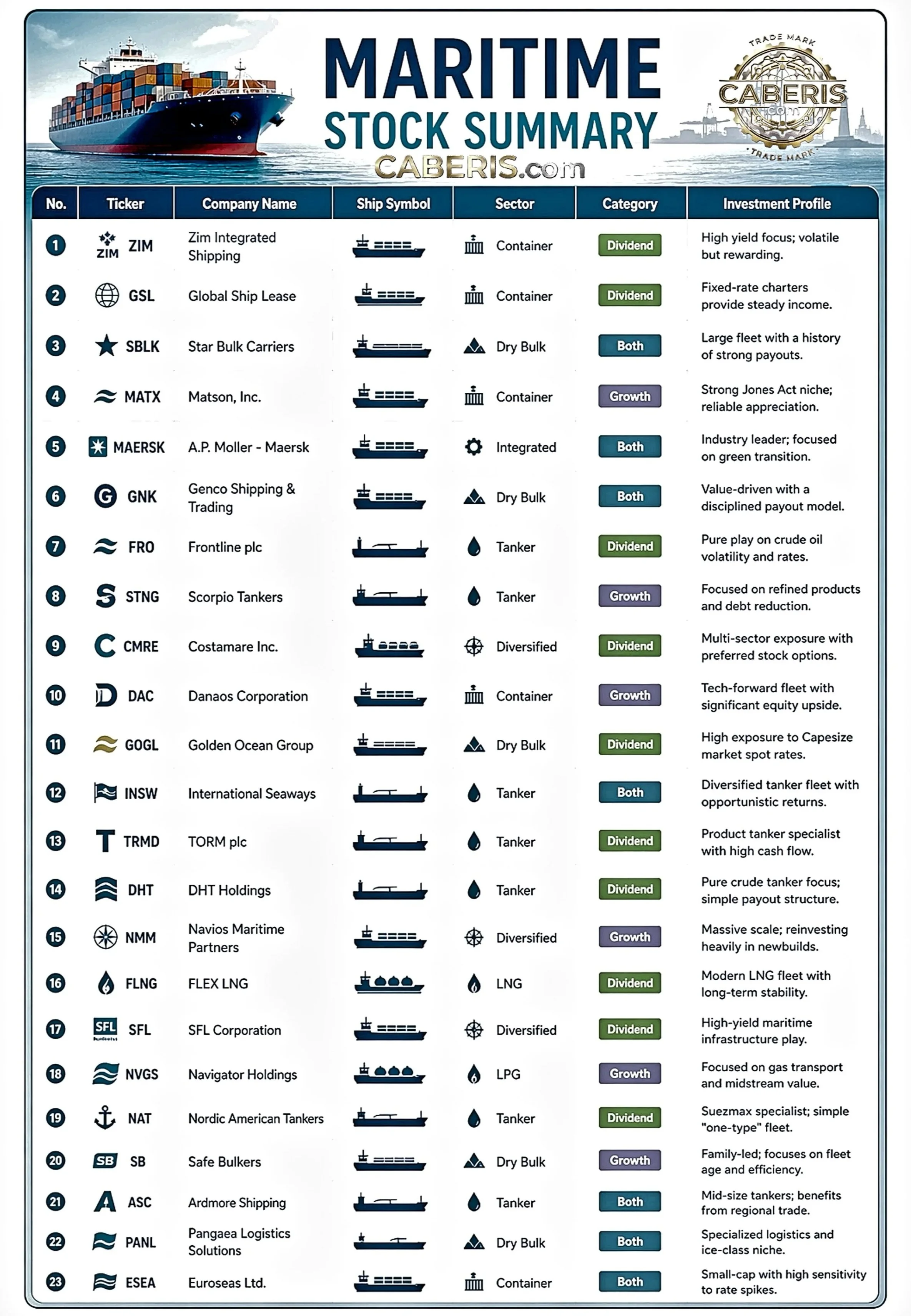
This image provides a comprehensive visual overview of the Maritime Stock Summary, serving as a strategic tool for analyzing the shipping sector in 2026.
he photo is organized as a professional data table that categorizes 23 different shipping companies based on their primary investment characteristics. It features a clean, high-end design with the caberis.com branding, using specific icons and color-coded labels to help investors quickly identify the right equities for their portfolios.
Image Overview
Key Data Points
The table is broken down into several informative columns:
Ship Symbol & Sector: Uses unique maritime icons to identify the sector, such as Tanker, Dry Bulk, Container, LNG, and Diversified.
Company & Ticker: Lists the official name and stock symbol (e.g., ZIM, FRO, SBLK) for each of the 23 entries.
Ship Symbol & Sector: Uses unique maritime icons to identify the sector, such as Tanker, Dry Bulk, Container, LNG, and Diversified.
Green (Dividend): Stocks prioritizing direct earnings distributions and consistent passive income.
Purple (Growth): Companies focusing on share price increases and reinvesting in fleet modernization.
Blue (Both): Industry leaders offering a hybrid of steady dividends and potential for capital appreciation.
Expert Insight: The final column provides a "Strategic Note" for each stock, such as Frontline (FRO) being a "pure play on crude oil volatility" or ZIM having a "high yield focus".
This visual summary is designed to be used alongside the Shipping Stocks and ETFs Command Center to track real-time movements and manage positions during global market shifts.Maritime Stock Identification Key: Dividends and Growth
To easily navigate the maritime market, I have provided a comprehensive list of stocks categorized by their investment profile. Use the key below to identify which companies focus on consistent dividend payouts, which are positioned for capital growth, and which offer a hybrid of both. This list serves as a practical tool for organizing your research and selecting the equities that best align with your financial strategy in the shipping sector.
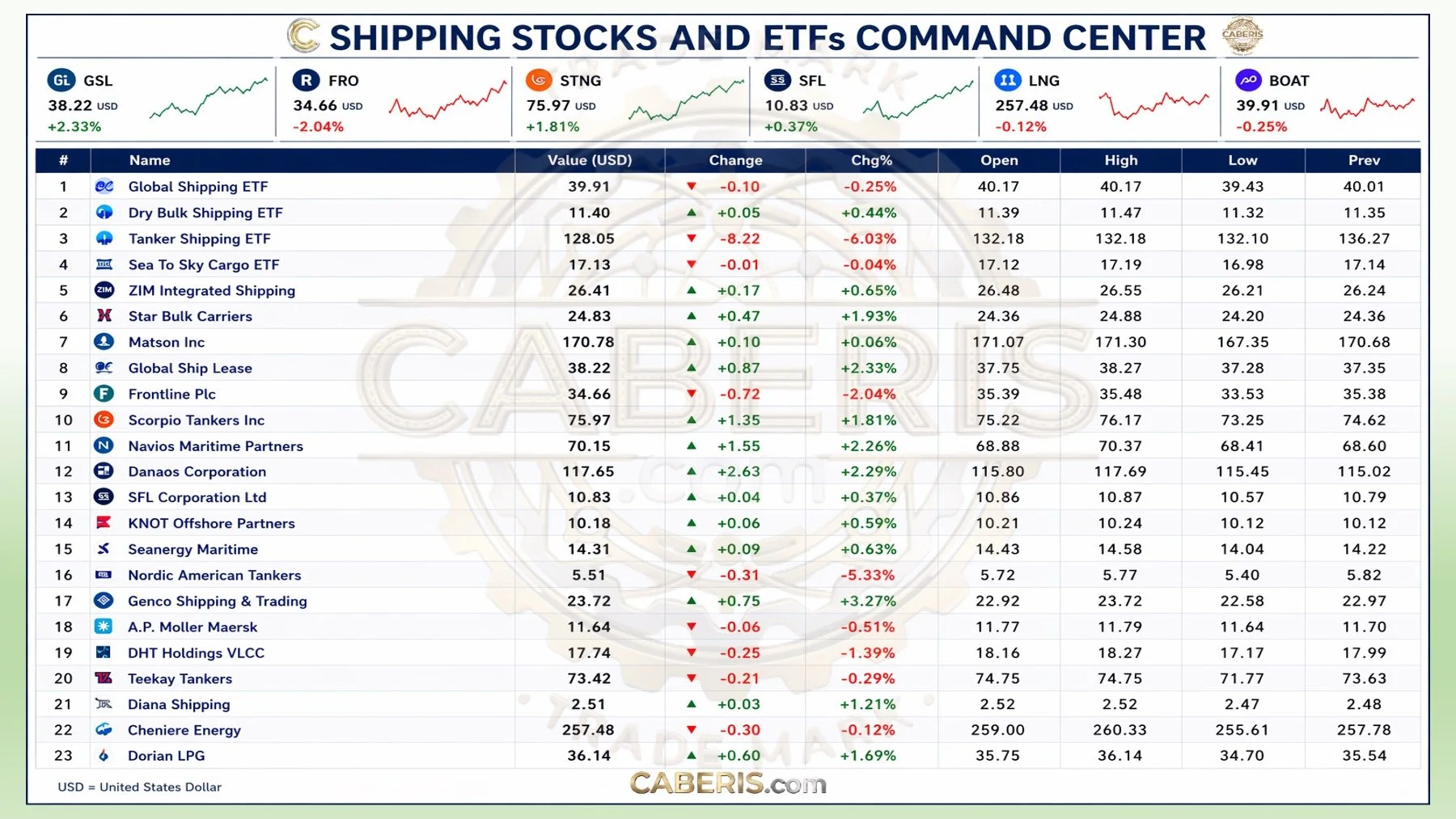
The Price is the first word in the language of the market. It is the immediate, non-negotiable reflection of global trade health and investor confidence. Before looking at debt or dividends, we look at the price to see where the world is placing its bets. You can monitor Price Movement here.
This trading view serves as your primary lens into the maritime sector. By tracking these real-time valuations, you can see exactly how geopolitical friction and trade demand are being priced into the ocean economy. Whether an asset is gaining or losing ground, the price provides the initial "go/no-go" signal for strategic asset management.
I. The Tanker Sector (Energy Transport)
These assets move the world's crude oil and refined products. They are highly cyclical and often provide the largest dividend windfalls.
Frontline plc (FRO) | Type - Stock
Strategy: Dividend Payer
Frontline operates a massive fleet of VLCC and Suezmax tankers as a dominant force in the energy sector. The company is currently executing a strategic fleet renewal program involving the sale of eight older vessels for US1.224 billion. For the first quarter of 2026 Frontline reported contracted VLCC spot rates reaching US1.03 per share in March 2026 as management continues to convert market volatility into direct cash returns.
DHT Holdings (DHT) | Type - Stock
Strategy: Dividend Payer
DHT is a pure play income provider focused exclusively on Very Large Crude Carriers. In April 2026, the company estimated its fleet time charter equivalent earnings at US91,700 per day. Forward bookings for the second quarter of 2026 appear even stronger, with forty nine percent of available spot days already reserved at an average rate of US$189,500 per day. The company maintains an attractive dividend yield of nine point fifty five percent as it returns nearly all net income to its shareholders.
Nordic American Tankers (NAT) | Type - Stock
Strategy: Dividend Payer
NAT focuses exclusively on a uniform fleet of Suezmax tankers to ensure highly efficient operations and maintenance. Chaotic conditions in global energy corridors have created increased transportation work for the company throughout early 2026. The board declared a fourth quarter 2025 cash dividend of US$0.17 per share, which was paid to investors in March 2026. Management remains committed to a transparent income model that offers a direct way to profit from rising oil transport rates.
Scorpio Tankers Inc (STNG) | Type - Stock
Strategy: Capital Appreciation
Scorpio specializes in the transport of refined fuels like gasoline and jet fuel using one of the youngest fleets on the water. In April 2026, the company entered into agreements to sell six older product tankers for US$300 million to monetise mid-aged tonnage. Management is currently building ten newbuildings, including four MR vessels and two VLCC tankers, with deliveries scheduled through 2029. Instead of prioritizing high immediate payouts, the company focuses on debt reduction and significant share buyback programs to drive long-term equity growth.
Teekay Tankers (TNK) | Type - Stock
Strategy: Capital Appreciation
Teekay manages a diverse fleet of Aframax and Suezmax tankers while maintaining a record cash position that exceeds its total debt. The stock hit an all time high closing price of US$78.21 in early April 2026, reflecting its significant financial strength. Institutional investors like Hartree Partners reduced their stakes in early 2026 to realize profits after the stock surged eighty percent over the prior year. The company continues to prioritize fleet renewal and operational flexibility to capture momentum in the maturing tanker cycle.
II. Dry Bulk Sector (Raw Materials)
These ships carry the raw materials of global infrastructure such as iron ore, coal, and grain.
Star Bulk Carriers (SBLK) | Type - Stock
Strategy: Dividend Payer
Star Bulk is a leader in dry bulk transport utilising fuel-saving technology to maximize its margins on global trade routes. The company reported a net income of US0.37 per share paid in March 2026. Management projects a second-quarter 2026 earnings per share of US$0.83 as it optimizes its fleet for industrial growth cycles. An annual meeting of shareholders is scheduled for May 12 2026, to discuss further capital allocation and shareholder value initiatives.
Genco Shipping and Trading (GNK) | Type - Stock
Strategy: Dividend Payer
Genco focuses on a high payout ratio and a transparent value strategy while maintaining a low debt balance sheet. In early 2026, the company became the target of a hostile takeover bid from Diana Shipping at US$23.50 per share. Genco management rejected the offer in March 2026 as it sought to preserve its independent dividend strategy. The company remains a preferred asset for quarterly money collection due to its disciplined approach to returning value to shareholders.
Diana Shipping (DSX) | Type - Stock
Strategy: Dividend Payer
Diana Shipping provides defensive income through the use of staggered long-term leases for its dry bulk vessels. The company has recently taken a more aggressive stance by escalating its takeover bid for Genco Shipping into a proxy fight as of April 2026. By seeking to merge with a competitor, the company aims to create a larger raw materials powerhouse capable of better navigating market dips. Despite the potential merger activities, the existing model of conservative chartering continues to provide resilient income streams.
Seanergy Maritime (SHIP) | Type - Stock
Strategy: Dividend Payer
Seanergy is a pure play Capesize shipowner focusing on the massive vessels required for steel production and industrial growth. The company is currently executing a US29,300 per day. Shareholders received a total cash dividend of US$0.43 per share for 2025 under a policy that distributes fifty percent of free cash flow.
III. Container and Logistics Sector (Consumer Goods)
This sector moves everything from electronics to clothing and represents the most visible part of the global supply chain.
ZIM Integrated Shipping (ZIM) | Type - Stock
Strategy: Dividend Payer
ZIM utilizes a tech-focused and asset-light approach to move consumer goods across major global trade lanes. The company is highly exposed to the spot market, which allowed for windfall-style payouts during recent rate spikes. As of April 1 2026, spot rates from the Far East to North Europe and the Mediterranean have climbed by thirty percent since the end of February. This leverage makes the stock a primary target for capturing massive dividend windfalls when supply chain disruptions tighten effective capacity.
AP Moller Maersk (AMKBY) | Type - Stock
Strategy: Capital Appreciation
Maersk is transforming into an integrated logistics provider by owning everything from ships to warehouses and trucking fleets. The company reorganized its logistics operations into three subsegments known as Landside, Forwarding, and Solutions to stabilize earnings. For the full year 2026 management has issued EBITDA guidance of US7.0 billion while implementing cost saving programs. While the company faces structural overcapacity in its ocean business it remains a core holding for long term growth in global end to end supply chains.
Matson Inc (MATX) | Type - Stock
Strategy: Capital Appreciation
Matson provides ocean transportation to domestic non-contiguous economies including Hawaii, Alaska, and Guam under the protection of the Jones Act. The company expects its full year 2026 consolidated operating income to approach the US0.36 quarterly dividend and ongoing share repurchases.
Danaos Corporation (DAC) | Type - Stock
Strategy: Capital Appreciation
Danaos is a leading independent owner of modern containerships with a contracted charter backlog of US1.4 billion. Management is utilizing this capital to build twenty-seven newbuilding vessels and has retired over 3.2 million shares through active buyback programs. The stock reached a new fifty-two week high in April 2026 as investor confidence built following a strong fourth quarter earnings beat.
IV. Leasing and Specialized Infrastructure
These companies act as the landlords of the sea or provide the essential infrastructure that makes shipping possible.
SFL Corporation Ltd (SFL) | Type - Stock
Strategy: Dividend Payer
SFL is known as the Maritime Landlord and owns a versatile fleet of tankers and container ships leased under long term contracts. The company has a historic twenty two year record of uninterrupted dividends and filed its 2025 annual report in March 2026. In early 2026 the company announced a major US$170 million contract for its semi submersible rig known as Hercules. This model prioritizes income sustainability and predictable quarterly cash flows through every phase of the shipping cycle.
Global Ship Lease (GSL) | Type - Stock
Strategy: Dividend Payer
Global Ship Lease owns mid sized and smaller container ships leased to global liners like Maersk and MSC under fixed rate contracts. The company has already locked in forward contract cover for ninety nine percent of its 2026 earning days providing high revenue visibility. Management increased the annualized dividend to US$2.50 per share in early 2026 while continuing to modernize its fleet with fuel efficient vessels. Q1 2026 earnings are estimated to be released on May 18 2026 with analysts projecting continued earnings growth.
Dorian LPG (LPG) | Type - Stock
Strategy: Dividend Payer
Dorian LPG operates a modern fleet of twenty eight very large gas carriers that move liquefied petroleum gas globally. For the quarter ending March 31 2026 the company fixed ninety nine percent of its fleet calendar days at rates exceeding US0.70 per share in February 2026 reflecting the strong demand in the gas market. The company continues to generate record profits as the world shifts toward cleaner burning energy sources.
KNOT Offshore Partners (KNOP) | Type - Stock
Strategy: Dividend Payer
KNOP operates highly specialized shuttle tankers that move oil from offshore rigs to land based terminals in Brazil and the North Sea. In April 2026 the board declared a quarterly cash distribution of US$0.05 per common unit representing a renewed focus on shareholder returns. The partnership has secured ninety eight percent charter coverage for the first half of 2026 and terminated previous buyout discussions to pursue independent growth. These technical vessels operate on long term contracts that are largely isolated from broader shipping volatility.
Navios Maritime Partners (NMM) | Type - Stock
Strategy: Dividend Payer
Navios owns a massive multi sector fleet spanning tankers, dry bulk, and container ships designed for scale and stability. Management approved a twenty percent increase in the quarterly distribution to US3.4 billion contract backlog Navios provides a steady foundation for dividends that benefit from multiple parts of the global maritime economy.
Cheniere Energy Inc (LNG) | Type - Stock
Strategy: Capital Appreciation
Cheniere is an infrastructure powerhouse that makes the global gas trade possible through its massive liquefaction and export terminals. In February 2026 the Department of Energy approved a twelve percent expansion in exports at the Corpus Christi terminal. The board of directors has upsized its share repurchase authorization to over US$10 billion through 2030 to return significant value to owners. This blue-chip asset is held for its market dominance and increasing net worth rather than immediate high yield dividends.
V. Maritime ETFs (The Market Pulse)
These funds represent the overall health of the shipping industry and track the movements of freight markets.
SonicShares Global Shipping ETF (BOAT) | Type – Exchange Traded Fund (ETF)
Strategy: Dividend Payer
BOAT serves as the pulse of the maritime industry by holding a basket of the top one hundred influential shipping stocks. As of March 31 2026 the ETF was up twenty-nine point eighty nine percent year to date on a price basis. It provides a steady stream of quarterly distributions with a recent dividend payment of US$0.85 per share and a yield of six point thirty nine percent. This diversified exposure is an essential tool for balanced oversight of the global maritime market.
US Global Sea To Sky Cargo ETF (SEA) | Type – Exchange Traded Fund (ETF)
Strategy: Capital Appreciation
SEA tracks the global cargo chain across sea, land, and air including holdings in major logistics firms like FedEx and UPS. This fund is a long-term growth asset that has seen a seventeen-point zero eight percent increase in net asset value in early 2026. It benefits from the increasing complexity and volume of global e commerce and international trade patterns. The ETF offers exposure to the broader logistics environment beyond pure play shipping.
Breakwave Dry Bulk ETF (BDRY) | Type – Exchange Traded Fund (ETF)
Strategy: Capital Appreciation
BDRY is a specialized fund that buys dry bulk freight futures instead of stocks to profit from rising raw material transport costs. As of late March 2026 the ETF was up fifteen point thirty nine percent year to date as it tracked a rally in the Baltic Dry Index. It does not pay a dividend and is primarily used as a technical tool for hedging against volatility in commodities like iron ore and coal.
Breakwave Tanker ETF (BWET) | Type – Exchange Traded Fund (ETF)
Strategy: Capital Appreciation
BWET provides direct exposure to the daily price of oil transport costs by tracking tanker freight futures. It has been the standout performer of 2026 with a year to date gain of over five hundred percent due to energy crises and route disruptions. Strategic managers use this high volatility tool to hedge or profit from spikes in the expense of moving global energy products. The fund utilizes cash collateral to back its futures contracts with maturities extending through late 2026.
The Current Outlook
As we progress through 2026, the industry finds that geopolitical tensions often catalyse rising shipping rates. Longer trade routes and increased ton-miles have become the standard, making fleet efficiency and carbon-neutral initiatives essential requirements for long-term value.
The maritime investment landscape now revolves around a cycle of constant disruption. This environment favors operators who maintain technological advantages and strict financial discipline. From the significant dividend payouts within the tanker sector to the strategic transformations of container giants, the industry continues to function as the essential backbone of the global economy. Investors should maintain a diversified approach across these stock categories to capture the benefits of global trade while managing the risks of geopolitical shifts and market overcapacity.